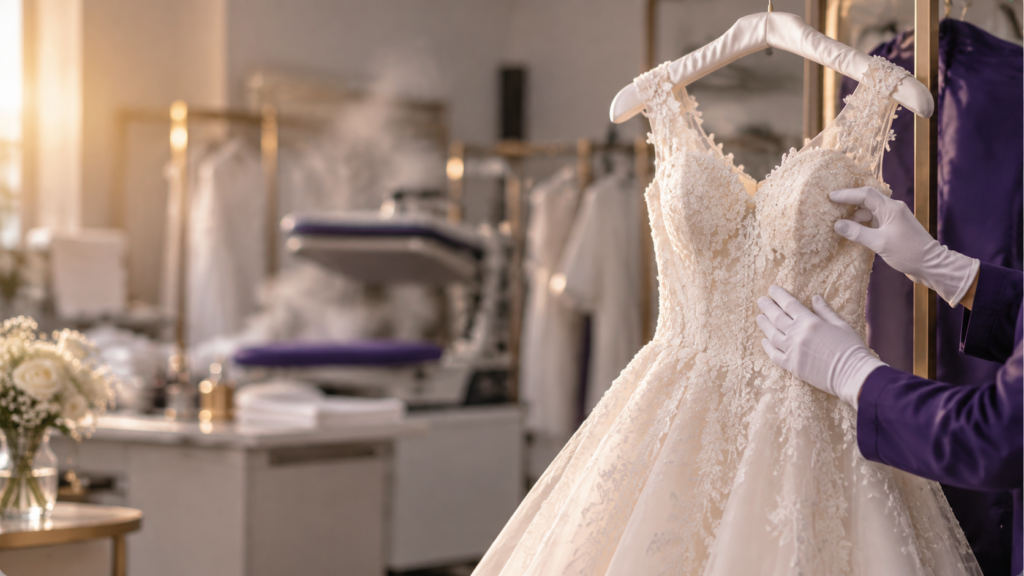
Why Wedding Dress Dry Cleaning Needs a Specialist, Not Just Any Laundry
Wedding gowns are built from layered fabrics — tulle, silk, lace, beading — that behave nothing like everyday clothing. A search for a generic dry cleaning near me option might work for a shirt, but a gown with hand-sewn crystals or a train that dragged across a venue floor needs someone who inspects before they clean. This guide covers exactly what to check before booking wedding dress dry cleaning in Kuwait, and where it differs from routine evening dress cleaning.
7 Things That Separate a Real Bridal Cleaner From a Regular One
| What to check | Why it actually matters |
|---|---|
| Documented experience with delicate fabrics | Tulle, silk and chiffon react differently to solvents than cotton — experience beats a nice storefront |
| Pre-cleaning inspection | Hidden stains (champagne, makeup) set permanently if not spot-tested first |
| Hand-finishing for beading and lace | Machine agitation loosens hand-sewn crystals and pearls |
| Gentle, residue-free solvents | Harsh chemicals cause yellowing on white and ivory fabric over time |
| Low-heat steam pressing | Direct high heat can scorch delicate lace instantly |
| Preservation packaging option | Protects the gown from dust, light and moisture if you’re keeping it as a keepsake |
| Damage guarantee or insurance | Shows the cleaner is confident enough in their process to back it |
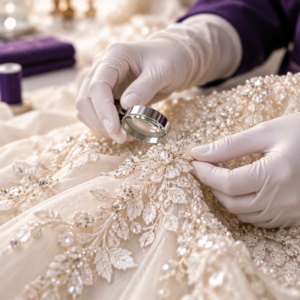
Wedding Gown vs. Evening Dress Cleaning: Is It the Same Service?
Not always. A simple evening dress with no train and minimal beadwork can usually go through a standard evening dress cleaning process safely. A full wedding gown adds two extra variables: a train that has physically touched the floor and collected ground-in dirt, and dense beading or embroidery that needs piece-by-piece hand inspection. If your dress is a lighter evening style, a general bridal-capable cleaner is often enough — a full wedding gown deserves a service that explicitly lists bridal specialization.
Before You Drop Off the Dress: A Quick Preparation Checklist
A few minutes of preparation before handoff makes the inspection process faster and more accurate, and reduces the chance of a stain being misdiagnosed:
- Point out every stain you’re aware of, even faint ones — don’t assume the cleaner will spot everything on their own.
- Mention if any stain was already treated at home with soap or water, since that can change how deeply it has set.
- Note any loose beads, torn seams, or fabric already in the process of unraveling before cleaning begins.
- If the dress was rented or borrowed, mention it — some fabrics used in rental gowns require gentler solvent concentrations.
- Take your own photos of the dress before drop-off as a personal record, separate from the cleaner’s intake documentation.
What Actually Happens Inside a Specialist Cleaner
- Intake & photo documentation of every visible stain or fragile area before anything is touched.
- Spot test on an inner seam to confirm the solvent won’t affect color or texture.
- Cleaning — hand treatment for beaded sections, appropriate solvent method for the rest of the fabric.
- Low-heat steam pressing to restore shape without flattening lace detail.
- Final inspection and packaging, with an optional preservation box for long-term storage.
Common Wedding-Day Stains and How a Specialist Treats Them
Most brides assume a “clean-looking” dress has no stains at all — but champagne, foundation and henna are notorious for staying invisible until they oxidize weeks later into a permanent yellow or brown mark. A specialist doesn’t just run one wash cycle; each stain type gets a different pre-treatment before the dress ever touches a solvent.
| Stain type | Treatment approach |
|---|---|
| Champagne or wine | Pre-treated with a mild alkaline solution before solvent cleaning, since sugar residue caramelizes and darkens if cleaned with heat alone |
| Foundation or makeup | Oil-based, so it’s broken down with a targeted degreasing agent applied directly to the fabric fibers, not sprayed generally |
| Henna or dye transfer | Requires immediate spot treatment; the longer it sits, the deeper the pigment binds to light-colored fabric |
| Grass or dirt on the train | Brushed dry first to remove particles, then treated — washing dirt in wet actually pushes it deeper into the weave |
| Sweat and deodorant (underarm area) | Enzyme-based pre-treatment, since standard detergent alone often can’t break down protein-based residue |
How Much Does Wedding Dress Cleaning Cost in Kuwait?
Pricing varies mainly by three factors: the number of fabric layers, the density of beading or embroidery, and whether preservation packaging is added afterward. As a rule of thumb, a simple evening dress with minimal detailing costs noticeably less than a full ball-gown-style wedding dress with a train and heavy hand-sewn embellishment, because the labor time for hand inspection and finishing scales directly with those details — not with the brand or price of the dress itself. Always ask for a price confirmation before the gown is accepted, rather than after cleaning is already underway.
Why Kuwait Residents Book This Through Otti
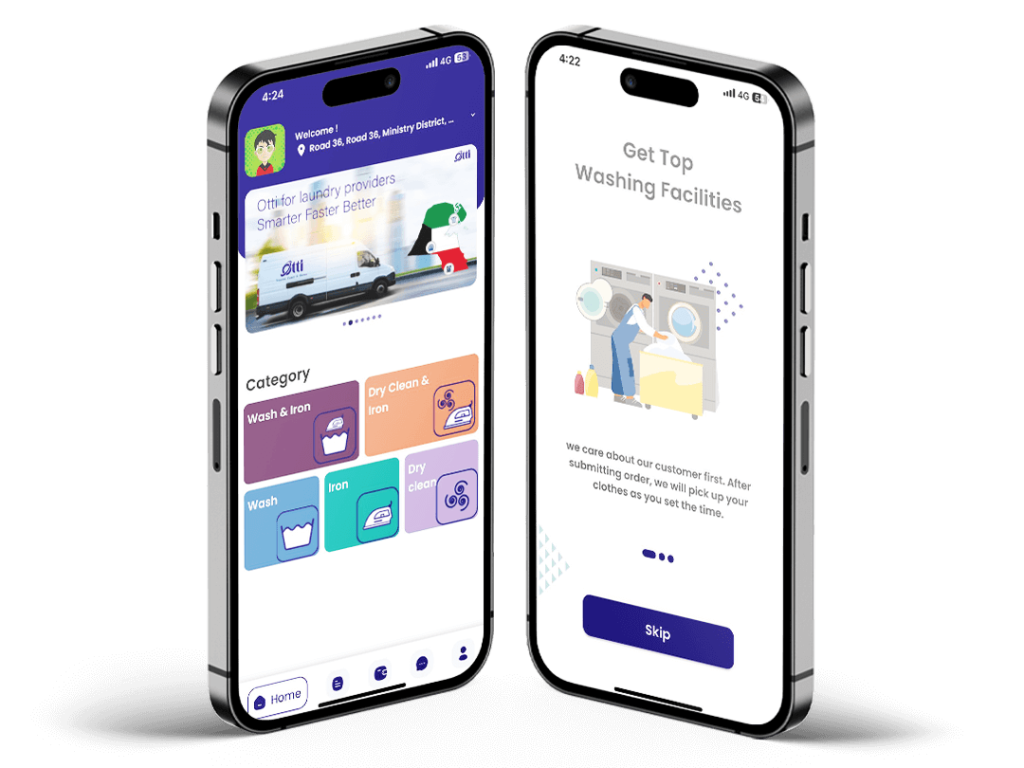
A delicate gown is the last item you want to hand to an unfamiliar shop found through a random dry cleaning near me search with no track record for this specific type of garment. Otti connects you to a network of partner cleaners specifically experienced with delicate garments — gowns, abayas, fine linens — rather than a single fixed workshop, which means better availability even during the busiest wedding seasons of the year. You get live order tracking from pickup to delivery, a clear price shown before you confirm the request, and pickup scheduling that works around your own timeline rather than the cleaner’s fixed hours. If you clean formal pieces often — evening dresses for repeated events, or abayas for weekly occasions — it’s also worth checking the monthly subscription plan instead of booking one-off every time, since the per-piece cost usually works out lower under a subscription plan.
💜 Top up your wallet in the app and get a 25% bonus instantly
Add 20 KWD to your Otti wallet and your balance becomes 25 KWD automatically — enough to cover your next wedding or evening dress cleaning at a real discount. The balance currently has no expiry date, so it simply stays in your account until you use it. Top up now
Frequently Asked Questions
What’s the difference between a regular cleaner and a bridal-specialized one?
A bridal specialist runs a pre-clean inspection and spot test, and hand-finishes beaded or embroidered sections. A regular cleaner usually runs one standard cycle regardless of how delicate the garment is.
Can I clean a wedding dress at home?
It’s not recommended. Home detergents and washing machines can loosen beadwork or permanently distort delicate fabric — professional wedding dress dry cleaning is the only safe route for a garment this valuable.
How soon after the wedding should the dress be cleaned?
Within two weeks at most. Invisible stains from sweat, perfume and makeup gradually oxidize into permanent yellow marks the longer they sit untreated.
Will dry cleaning change the color or shape of my dress?
Not when a spot test is done first by a professional cleaner. The real risk only appears with home cleaning or a non-specialized shop that skips that step.
Is wedding dress cleaning more expensive than evening dress cleaning?
Usually yes — the hand inspection and cleaning required for a train and heavy beadwork take significantly longer than a simple evening piece with no embellishment.
Should an evening dress be cleaned even if it looks fine?
Yes. Invisible sweat and perfume residue builds up in the fibers even without a visible stain, and gets harder to remove the more times the dress is worn between cleanings.
Can a wedding dress be preserved for years after cleaning?
Yes, if it’s wrapped in a breathable fabric garment bag (not sealed plastic, which traps moisture) and stored away from direct sunlight and humidity, it can last for years without yellowing.
Get your gown ready for the next event — safely, without risking a stain that can’t be fixed
Or message us directly on WhatsApp: +965 5656 0404